
Workflow is Functionality
Functionality, the range of operations that can be run in a computer system, is the foundation upon which all software product collateral, designs, discussions and comparisons are based. Customers buy on functionality. Developers create functionality. Users question what the product can do.
That is fine, but it’s not the whole story.
The right question is not what operations exist (or should exist), it’s how these operations work together, how the functionality flows. How can you tell which operations have been performed, and what operations need to be performed next? That is workflow. The product’s collateral should tell the customer how the workflows in this software helps them run their business better. The workflows in a software plan should tell the developers what functions are needed and which can be ignored. The workflows in software help users learn and track what they are doing.
Multi-Platform Editing is Sublime
One of the best things about the Sublime Text 2 license is that it’s a per-user license. This allows you to run it on all computers where you are the primary user. And since Sublime Text 2 is multi-platform, that means on all the operating systems you use as well.
For example, in my case, I can and do run Sublime Text 2 on
- My laptop Macintosh which is my regular workhorse.
- My OS X Server for maintaining Slogger and other scheduled scripts.
- My Windows 7 VM which is where I do all my Windows coding and testing.
- And on all my GUI Linux VMs too.
No more jumping between TextMate, UltraEdit, and GEdit. Or worse, having to use Notepad because nothing else is installed.
Hiltmon.com - One Year Old

On Nov 22, 2012, the revamped hiltmon.com turned one year old. And I missed it as I was too busy guzzling turkey.
Thank you all for reading, sharing and responding to my writing.
Stats from the First Year
- 287 posts.
- 67,536 pageviews.
- Taking the HN/Reddit outliers out, hiltmon.com is averaging 4,278 page views per month.
- Over the year, 41.66% of visitors used Chrome, 20.82% used Firefox and 20.07% used Safari. But over the last 6 months, this has changed to 36.31% Chrome, 34.62% Safari and 13.97% Firefox, tracking the demise of Firefox.
- Over the year, 36.66% of visitors were on Windows, 33.27% Macintosh and 11.55% on Linux. Over the past 6 months, this has changed to 44.94% Macintosh, 28.37% Windows, 16.15% iOS and 7.12% Linux tracking the tone and content of this site.
- Only 18.17% of page views are from mobile devices and this rate is growing rapidly. 84.2% of mobile access is from iOS devices and the remainder seem to be Android variants.
- 57.1% of page views source from from Google searches, 21.9% direct and 5.2% from Twitter and Facebook.
- $0 spent on advertising and marketing. My plan was to focus on writing only this year and see how it went.
The Top 10 most popular articles
- The Markdown Mindset
- It Should Only Take You a Few Hours…
- The Paradox of Choice
- Project Folder Layout
- 2012 iPad Essentials
- Not Your Free Tech Support
- My Sublime Text 2 Setup
- Quick and Dirty Rails Performance Profiling
- Test Driven Development Really Works
- Text Editing Fonts and Colors
Once again, thank you all for reading hiltmon.com and sharing this site with your friends. I intend to continue writing here on the topics that interest us all, especially software design, productivity ideas and about awesome tools that I love to use.
Vegemite Sandwich
It’s Thanksgiving here in the USA today and all us good Aussies are making our own comfort food, Vegemite Sandwiches. If you have listened to the Men at Work song Down Under, you’ve heard of this magical foodstuff.
Here’s how to do it right.
The Ingredients
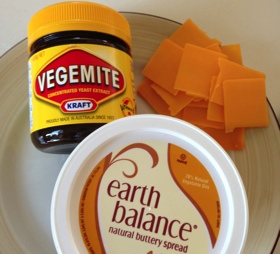
- 2 x slices of bread (most prefer fluffy white, I prefer a wholegrain brown). One is never enough, and more than two is only allowed after a vigorous rugby game.
- Butter or margarine to taste.
- Vegemite
- Cheddar cheese (actually New York cheddar is very good for this), sliced thinly using a cheese slicer.
Preparation
- Very lightly heat up the bread, I run it in the toaster for 15 seconds. Do not let it dry out or get toasty. The idea is to warm up the bread so that the butter melts easily when spread. There are those who incorrectly believe in buttering cold bread, but forget that Australia is a warm country and this is Australian food.
- Spread the butter on the bread. Do not overdo it. Ensure the the top of each slice is moist, but not soggy. If the butter dribbles through the bread and hits the plate, you’ve put too much on and should start again.

- Spread the Vegemite on top of the butter. The Vegemite should be slathered thick, and be spread to all edges of the bread. Leaving un-Vegemited corners is sloppy and proves that you are a pommy bastard who is used to marmite sandwiches where only the very centre has a dab of flavor. And while we are on poms, what’s with the marmalade thing?

Place the cheese on top. Ensure proper coverage, but leave a few millimeters on each edge for cheese expansion. If you use imperial measures, leave a 1/18 span (1/8 finger or gnats-thorax length) between cheese edge and crust edge.
Day One iCloud Sync Fail
This post seems to have become popular. To clarify, the problem is with iCloud, Day One is just plain brilliant and you should all be using it.
I use the Day One journalling program a lot, especially to log commits and all social activity using Slogger. But today I noticed that the Journals on all my devices were out of sync, and new entries created were not passed on to other devices. Somehow, sync was jammed up.
No Sale: It does not have what we can and will not use
As a buyer of software, I always focus on what the software does do. If it does what I need to do well, and the price is right, I buy it, I use it and I gain the productivity benefits from it.
As a seller of software, I find potential customers focus on what the product does not do, and use this as a reason to avoid purchasing. That’s fine as long as the missing feature is something they can and do or will use. But it makes no sense to me when the missing feature is something that they already have and do not use, don’t know how to use or have no reason to use.
Python Zen
After reading Federico Viticci’s Automating iOS: How Pythonista Changed My Workflow, I think its time I added the Python Programming Language to my repertoire.
The first thing I learned about Python is the Zen of Python by Tim Peters:
- Beautiful is better than ugly.
- Explicit is better than implicit.
- Simple is better than complex.
- Complex is better than complicated.
- Flat is better than nested.
- Sparse is better than dense.
- Readability counts.
- Special cases aren’t special enough to break the rules.
- Although practicality beats purity.
- Errors should never pass silently.
- Unless explicitly silenced.
- In the face of ambiguity, refuse the temptation to guess.
- There should be one – and preferably only one – obvious way to do it.
- Although that way may not be obvious at first unless you’re Dutch.
- Now is better than never.
- Although never is often better than right now.
- If the implementation is hard to explain, it’s a bad idea.
- If the implementation is easy to explain, it may be a good idea.
- Namespaces are one honking great idea – let’s do more of those!
I think this really applies to all languages and programming in general.
Google Analytics Logger for Slogger
This article explains how to set up Brett Terpstra’s Slogger with a new plugin to journal your daily Google Analytics site stats. This plugin supports:
- Multiple web properties as long as they are under the same Google login.
- Multiple dates so you can skip a few Slogger run days and catch up (or back fill).
- Only logs a full day’s worth of stats, so if it runs now, it logs up to yesterday’s stats.
- Captures page views, visitors, top 5 sources and top 10 popular pages. If you want different stats, let me know in the comments or via Twitter @hiltmon.
Warning: This plugin is alpha code, so assume the usual no warranty legalize, basically proceed at your own peril.
Another Reason to love this Community
Friendly competition, another reason to love this community.
The gang at App.Net just released their new integrated stream marker feature.
The first response I see (at the top) is from Manton Reece (TW: @manton, ADN: @manton), the maker of Tweet Marker that competes with this feature, congratulating them on their implementation.
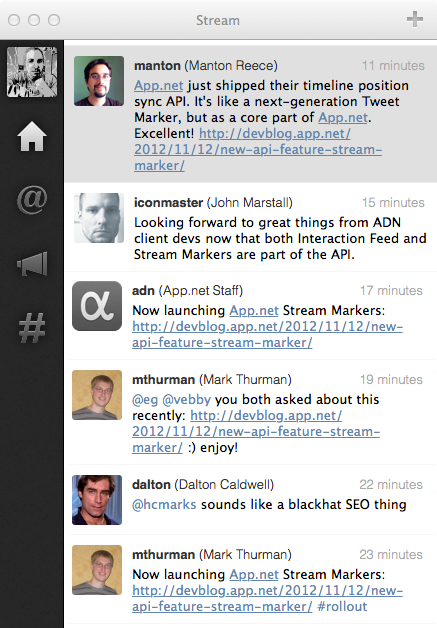
Screenshot off App.Net using Wedge.
Linking to Bullshit
While I was working on my Adverse Apple Articles post this morning, Marco Arment was writing this: Linking to bullshit:
If you truly dislike bullshit writing and don’t want to support it, hit the publishers where it hurts: don’t read it, and don’t link to it.
I only partially agree. If the site and the article is truly link bait, then sure, we should ignore it and not send others to it.